


Security teams aren’t losing because they lack data. They’re losing because the data is growing faster than any organization can turn into decisive action.
Organizations now face an average of 135 new vulnerabilities every day, 40% more than the year before. At the same time, AI-powered threats are accelerating attackers’ ability to exploit them, with a quarter of successful breaches occurring within 24 hours of a vulnerability being disclosed. And CISOs feel the shift directly. 78% say AI-driven attacks are already impacting their security posture.
This is the backdrop for a simple reality. The challenge is no longer “finding vulnerabilities.” It is proving which ones create real exposure in your environment, fast enough to matter.
The AI era changes the pace of exposure
AI does not just increase the number of alerts. It compresses the time between disclosure and impact.
When attackers can move faster, finding targets, adapting exploits, and operationalizing campaigns at scale, the cost of uncertainty goes up. Security teams do not have time to debate thousands of findings, and they cannot afford remediation programs that optimize for volume. In this environment, the winners will be the teams that can answer quickly and preemptively:
Where are we truly exposed, and what will reduce that exposure first?
That requires evidence grounded in how the environment actually works.
The problem isn’t vulnerability management. It’s decision-making under uncertainty.
Most vulnerability programs still operate using external context. Severity ratings, generalized exploit chatter, and outside-in signals are useful, but incomplete. They rarely answer the question that matters to the business:
Can an attacker exploit this in our environment, right now, to create a meaningful impact?
This gap drives the outcomes every CISO recognizes. Patch fatigue, production risk, endless backlog growth, and remediation efforts that are hard to justify because they are not tied to provable exposure reduction.
So we looked for a fundamentally different approach, one built to replace assumptions with proof.
What stood out about Astelia
Astelia’s approach is to model exposure the way attackers experience it. It combines deep, environment-specific reality with offensive-grade analysis to determine what it actually takes to exploit a vulnerability.
Astelia builds a living model of the enterprise environment by mapping topology, segmentation, and existing security controls. Autonomous AI agents trained by elite vulnerability research experts then analyze the technical prerequisites required for exploitation.
That enables a shift from volume-based vulnerability work to provable exposure reduction:
- Exploitability grounded in technical reality, not external scores
- Reachability and attack-path context that reflects the real environment
- Alternative remediation paths, not just patching, because Astelia maps topology, segmentation, and controls and understands how exposure is actually created.
The result is what security leadership actually needs. A short, preemptive set of actions that meaningfully reduces exposure without forcing unnecessary patches into production systems.
Why this team is uniquely qualified
At Team8, we back teams with asymmetric insight and the ability to execute with urgency. Astelia’s founders bring rare, end-to-end experience across real-world attack paths and large-scale defensive systems, and that worldview is embedded in the product.
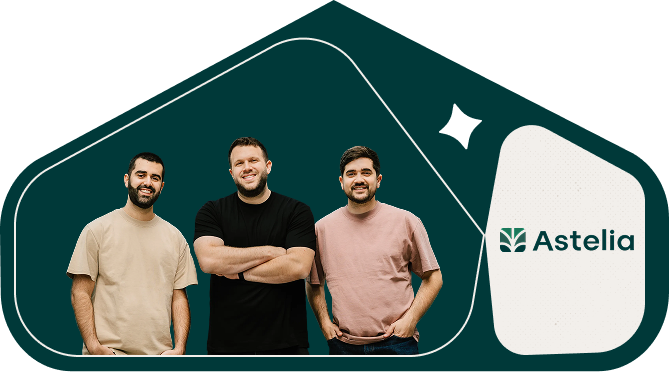
Just as importantly, the three co-founders have worked closely together before. Their operating cadence, trust, and synergy are evident. It is the kind of pre-integrated team dynamic that consistently shows up in speed of execution and clarity of product direction.
Looking ahead
We believe the next era of security leadership will be defined by a simple shift. From managing volume to demonstrating proof. Proof of exposure, proof of prioritization, and proof that remediation actions measurably reduced real-world risk.
That’s why we invested in Astelia, and why we’re excited to partner as they scale deployments and help enterprises move from reactive triage to evidence-driven exposure management, grounded in provable reachability rather than assumed risk.

Managing Partner
Amir Zilberstein is a Managing Partner at Team8, where he builds and invests in Cyber and Software Infra businesses.

Managing Partner
Aviad Harell is a Managing Partner at Team8. He builds and invests in Cyber and Software Infrastructure companies.