Simulation Infra for Trustworthy, Self-Improving AI Agents

Today Plurai announced $13M in seed funding and the general availability of its platform: the simulation infrastructure for trustworthy, self-improving AI agents. Team8 led the round, and we’re proud to have backed Ilan and Elad from day one.
As agents move into core enterprise workflows, the missing layer is infrastructure that builds trust in them before they reach customers and keeps them improving in production. We believe simulation will become as fundamental to the agent stack as CI/CD is to software. Plurai is building that layer.
AI agents are easier to create than ever. Making them work reliably with real customers is far harder. Not surprisingly, enterprises have deployed an AI agent or LLM feature that passed internal evaluations but still caused a customer-facing failure in production.
The gap shows up at two stages:
- Before launch: teams spend months manually checking their agents, but they can never anticipate every scenario agents will meet in production.
- After launch: using frontier LLMs to evaluate every interaction is too slow and too expensive to scale.
Ilan and Elad saw this challenge firsthand in autonomous driving. The same principle applies to agents: trust is built through testing and training. As Ilan puts it, “Waymo built trust by testing and training across more than 20 billion simulated miles, roughly 100 times its real-world driving.”
Ilan Kadar and Elad Levi both hold PhDs and have spent the past decade bringing reliable AI systems into production in mission-critical environments. They led efforts to build real-time, scalable, and reliable systems for autonomous-driving companies like Waymo, which rely on simulation to validate self-driving systems before they reach the road.
Simulation lets you challenge a system with the hardest situations and rarest events before it reaches users, learn from failures, and improve before those failures happen in the real world. Plurai brings that approach to AI agents.
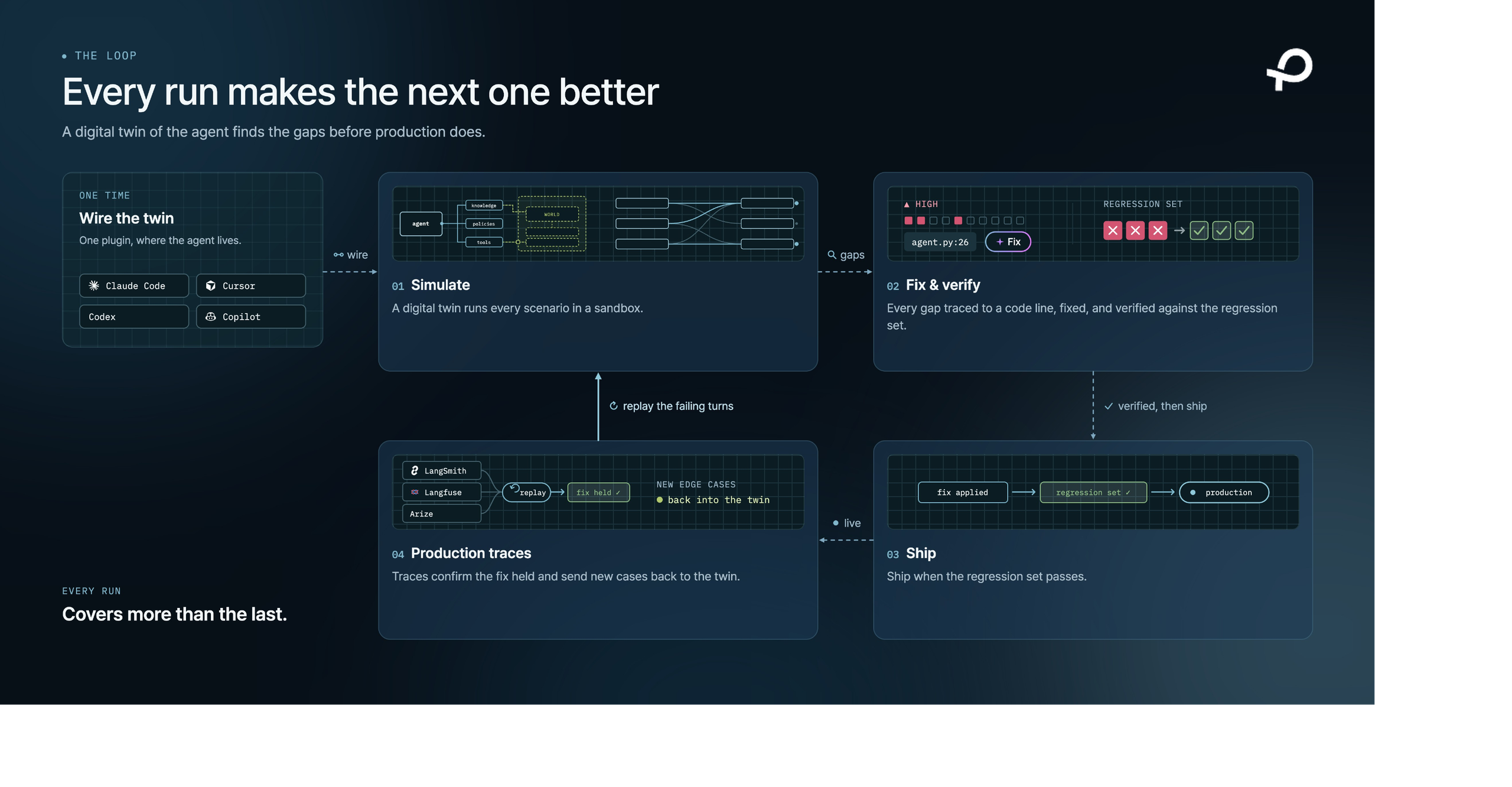
- Simulate. Plurai builds a digital twin of an agent and its world from the company’s own knowledge base, tools and policies. It then runs thousands of realistic and adversarial users against the agent in a sandbox. That covers the long tail of edge cases and exposes policy violations, hallucinations, incorrect actions, broken tool calls, failed tasks and sensitive data leaks.
- Optimize. The same simulation generates fixes for the failures it finds.
- Enforce in production. Plurai uses the simulation data to create small language models (SLMs) tailored to each agent. These compact models act as always-on reviewers, checking every action and enforcing company policy at a fraction of the cost of frontier LLMs. Companies can monitor every interaction rather than a small sample.
That loop is what makes agents self-improving: they find and fix failures before launch, then stay reliable and keep improving in production.
Plurai’s design partners are seeing the impact. Development cycles have dropped from months to hours, failures reaching real users are down 82%, and the cost of running reliable agents has fallen by 97%.
The approach also holds up against the strongest models available. In joint work with NVIDIA and Nebius for a global enterprise customer, a model Plurai post-trained outperformed OpenAI and Anthropic frontier models on accuracy, at 40x and 44x lower cost respectively.
Plurai already works with enterprises across AI-native and highly regulated industries, including Fortune 500 and major financial companies, and recently partnered with Eon to establish benchmarks for AI agents. Gartner named Plurai a Representative Vendor in its 2026 Market Guide for AI Evaluation and Observability Platform
Until today, Plurai was limited to select partners and customers. It’s now available to every agent builder, with a free tier. Developers can start from the tools they already use, including Claude Code, Codex, GitHub Copilot and Cursor. Teams can also simulate and improve agents built on enterprise platforms like Salesforce Agentforce.
Plurai’s technology is grounded in the company’s own original research:
- BARRED, a new method for generating synthetic training data for custom SLMs, accepted at ICML 2026.
- Research on serving hundreds of tailored SLMs in real time on a single GPU, which makes them economically viable at scale.
Their research and open-source projects are used by hundreds of thousands of developers worldwide.
Team8 has always backed the infrastructure that gives enterprises confidence to adopt what’s next. From cloud infrastructure to quantum software, that conviction is reflected in Port, which raised a $100M Series C to scale its Agentic Engineering Platform; Finout, which helps enterprises understand and control cloud costs; and Classiq, the quantum software company acquired by Intel for $2.3B.
In the agentic era, we believe simulation will be just as foundational, helping enterprises test and validate agents before they reach production.
Ilan and Elad bring deep AI expertise and more than a decade of bringing AI into high-stakes production systems. They’re the team to build that layer.
We’re proud to lead Plurai’s $13M seed round, with participation from U&I, Velocity and Mercer and backing from more than 20 angel investors and industry leaders.
Add infra efforts, village tour and more.
Learn more and get started at plurai.ai.