

Introduction
Venture capital is often described as a pattern recognition business. While significant attention is paid to portfolio construction, sector focus, and macro cycles, far less research exists about the investors themselves. What experiences and characteristics produce consistently successful VC investors, and why do so few go on to build durable firms?
These questions matter not only for managers, but for allocators as well. LPs seek access to top-performing investors, yet increasingly concentrate commitments in established platforms. At the same time, data suggests that first-time funds, often led by former founders, operators, and venture investors, have historically generated some of the strongest performance across the asset class. Nevertheless, structural barriers make it difficult for many of these managers to launch and scale, and for LPs to access them early.
Drawing on a decade’s worth of Forbes Midas List data, industry fundraising trends, first-time fund performance metrics, and key industry voices, we explore three questions:
In examining these questions, we identify the forces that constrain emerging managers and shape institutional access, illuminating the tensions, risks, and opportunities defining today’s evolving venture landscape. We conclude by outlining a set of design principles aimed at improving alignment and reducing friction across the emerging manager ecosystem.
Key Findings

Midas List leaders
Almost 70% of Midas List leaders have founder/operator backgrounds.
Among the nearly 50 Midas List recipients who appeared seven or more times between 2016-2025, almost 70% had prior founder or operator experience, while only about 20% rose solely through the traditional career VC path. Only 10% lacked prior exposure to founder, operator, or junior VC roles.
Global LP Commitments
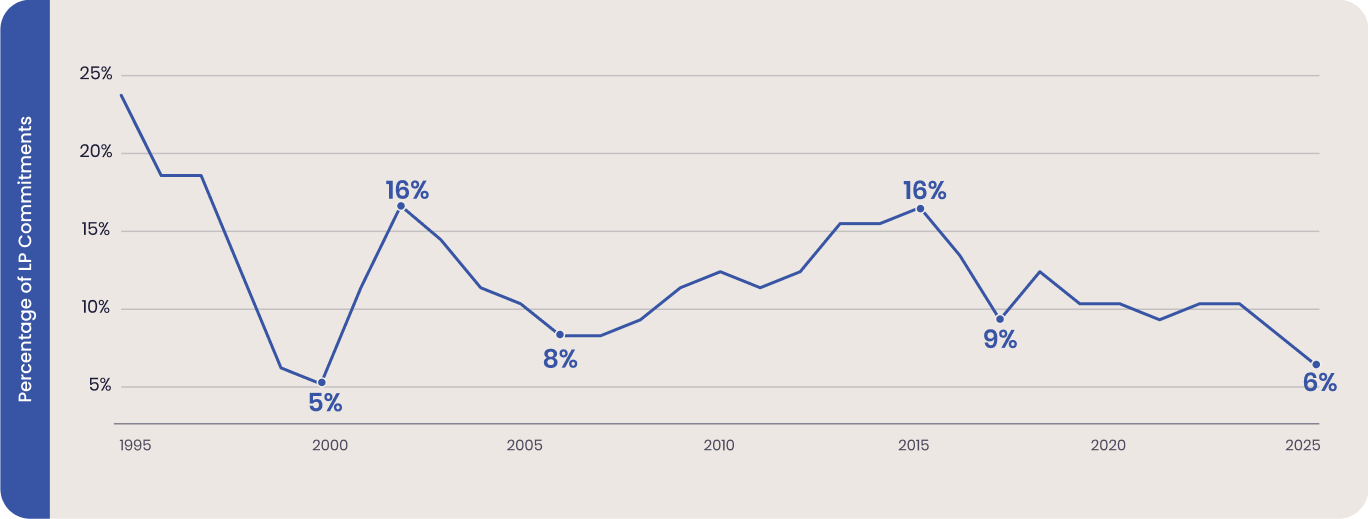
Small/first-time funds received the smallest share of LP commitments in nearly three decades.
In 2025, venture funds under $50M captured just 6% of global LP commitments, representing the lowest level since the dot-com crash. The median global early-stage Fund I size (2021-2025 vintages) is approximately $20M, and only about one-third of first-time funds go on to raise a Fund II.
Median Net IRR
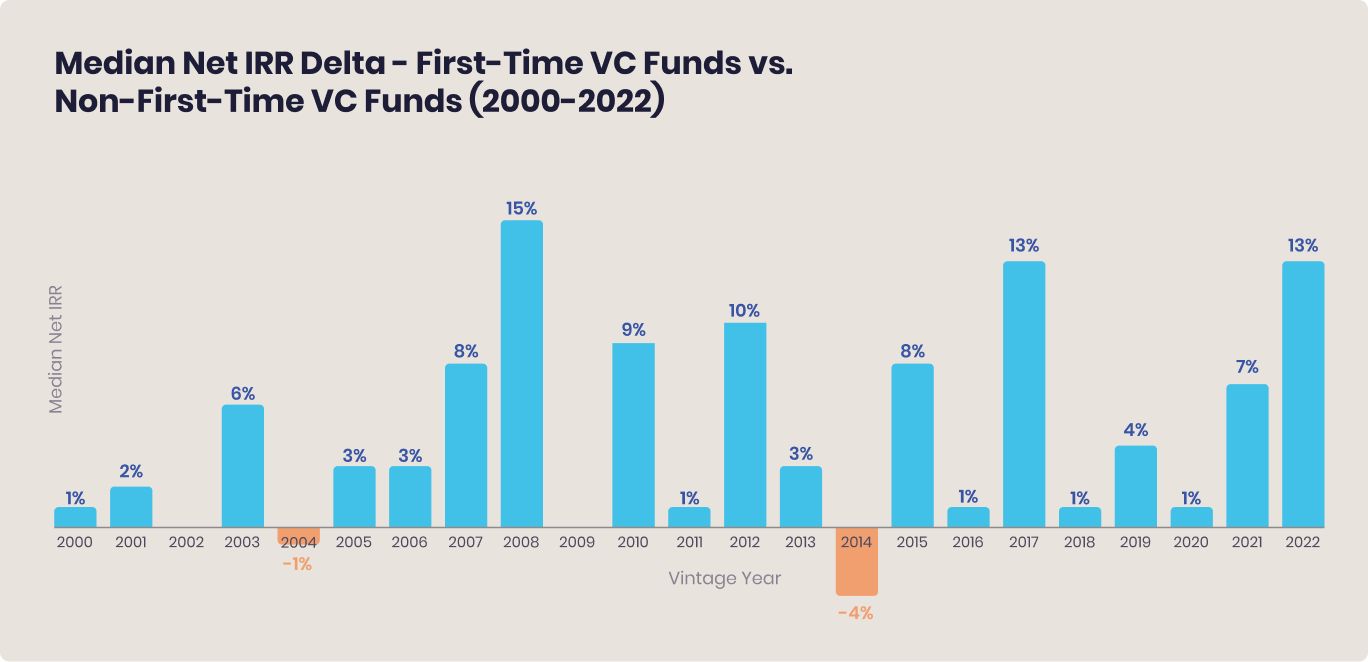
First-time funds outperformed established managers by up to 15% median net IRR.
Across 2000-2022 vintages, first-time VC funds generated meaningful median net IRR premiums relative to established managers. While dispersion is higher, the segment has repeatedly produced outsized returns.
Why It Matters
Taken together, these findings reveal a persistent structural gap between how venture firms are built and how institutional capital is allocated. While first-time funds have historically generated some of the industry’s strongest returns, structural barriers make them difficult to build and equally difficult for institutional LPs to underwrite early. Building a more efficient and aligned venture ecosystem requires new approaches that reduce formation-stage friction, preserve early access while managing risk, and narrow the timing gap between early signals of manager quality and institutional validation.
The Building Blocks of Great VC Investors
The industry’s most successful investors disproportionately come from founder and operator backgrounds.
To better understand the backgrounds of consistently top-performing venture investors, we analyzed a decade’s worth of Forbes Midas List data from 2016 through 2025 (representing 1,000 entries). The Midas List is Forbes’ annual ranking of the world’s top 100 tech venture capitalists. We focused on individuals who appeared seven or more times over the 10-year sample period. Applying this threshold produced a cohort of nearly 50 recurring Midas List leaders, representing those with sustained recognition rather than one-time outliers.
We then reviewed each qualifying investor’s professional background prior to becoming a leading VC, mapping their previous roles as they appeared, including founder, operator, career VC, finance professional, consultant, and other paths, and grouping them based on common career trajectories. Our objective was to determine whether a repeatable blueprint exists among consistently top-tier investors, and to understand what capabilities, beyond investing experience, most often precede sustained venture success.
90% of the individuals in our dataset had prior exposure to at least one of three roles before becoming Midas List leaders: founder, operator, or career VC.
In other words, nearly all sustained top-tier investors were either company-builders, functional leaders inside scaling organizations, or professionally trained within an established venture platform. These three backgrounds emerge as the dominant formative experiences preceding long-term success in venture, and accordingly, represent what we believe are the three most prevalent profiles within today’s VC manager landscape.
Furthermore, nearly 70% of Midas List leaders had meaningful founder and/or operator experience before becoming full-time investors, whereas only roughly 20% rose through the traditional venture apprenticeship path as career VCs, without prior founder or operator roles.
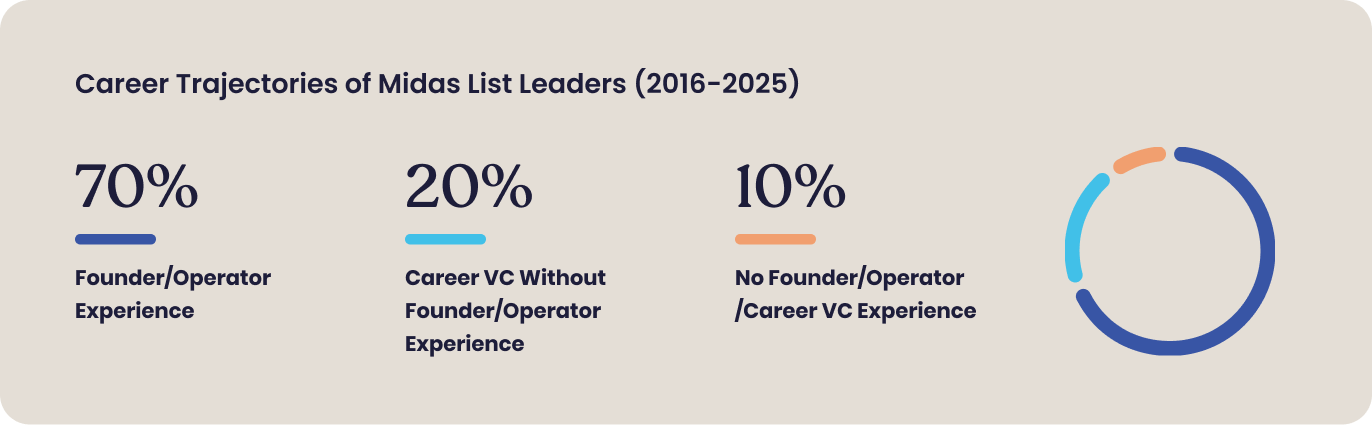
This concentration of backgrounds among sustained top-tier investors suggests something deeper: being a great investor is not solely about picking companies; it requires judgment shaped by firsthand experience building organizations, navigating uncertainty, hiring talent, and scaling systems. Founders and operators internalize these dynamics from the inside, developing pattern recognition not just around markets, but also around execution behavior.

“Having experienced hypergrowth at Google firsthand, I learned what an organization scaling at an extraordinary pace looks like from the inside. I also learned to view companies not simply as financial assets, but as living, breathing organisms shaped by people, products, and execution. Those perspectives have strongly influenced how I invest and have given me a deep appreciation for the challenges founders face as they build and scale companies.”


After all, a venture firm itself is an operating entity. It must raise capital, build infrastructure, manage governance, oversee reporting and compliance, cultivate a brand, and sustain an economic model over a decade-long lifecycle. Thus, the prevalence of founder and operator experience among top investors may be more than coincidence. We believe the skills required to build and scale companies are also relevant to building and scaling venture firms.
This perspective may help explain why, according to PitchBook,
Only one-third of first-time venture funds go on to raise a Fund II, with more recent cohorts performing even worse.
While launching a fund is difficult in its own right, transforming that initial vehicle into a durable venture firm is an entirely different undertaking.
The Challenges of Building a Venture Firm
Many of the people best positioned to become great investors face significant barriers to launching firms.
In many cases, the very individuals most likely to become great investors, i.e., founders, operators, and career VCs, already possess strong judgment and differentiated access. However, the skills required to set up and operate a venture firm go beyond investment capabilities like deal sourcing and selection. In fact, many of the challenges that first-time funds face look remarkably similar to those faced by startups, making the process of building a venture firm more akin to building a company than simply making investments. To understand this distinction more concretely, it is helpful to examine some of the core struggles that emerging managers face on the path from investor to VC firm-builder.
Fundraising Friction
For most first-time managers, fundraising absorbs the majority of time during the first 12–18 months. In an environment characterized by slower distributions, constrained LP budgets, and heightened risk sensitivity, allocators place a premium on track record, brand, and institutional durability — dynamics that disproportionately favor incumbents. Even when emerging managers possess differentiated sourcing access or subject matter expertise, they often face longer fundraising cycles and smaller initial closes, resulting in delayed deployment, reduced early momentum, and less time spent on the core activity of investing.
These market conditions are clearly reflected in broader capital allocation trends, where pressure on smaller funds – many of which are first-time funds – remains intense. Our analysis of PitchBook data shows that the percentage of total annual LP commitments allocated to venture funds under $50 million fell to approximately 6% last year, representing the lowest level since the dot-com crash. Small/first-time funds are competing for the smallest share of LP commitments in nearly three decades.
Global Percentage of Annual LP Commitments to Venture Funds Under $50M (1995–2025)
For LPs, these conditions create a separate problem: the fundraising process itself may influence which managers succeed, introducing a subtle selection effect. Part of the reason is that the skills required to identify and support great companies are not always the same as those required to raise capital. Building relationships with LPs, communicating a compelling narrative, and navigating institutional diligence require a distinct set of capabilities that many investors who spend years investing within established platforms may have limited exposure to. As a result, fundraising outcomes may not always be the best proxy for underlying investment potential, particularly among first-time managers.
Competition and Strategy Drift
If less capital is flowing to smaller funds, where is it going? Increasingly, allocators are concentrating capital among a small number of large, established venture firms. In 2024, PitchBook reported that just nine venture firms collected approximately half of all capital raised by U.S. venture funds. A year later, Forbes reported that Andreessen Horowitz raised a $15 billion fund that accounted for roughly one-fifth of all venture capital dollars raised in 2025. This behavior reflects the tendency of allocators in low-DPI environments to gravitate toward scale, brand, and perceived institutional stability.
However, scale comes with its own tradeoffs. As venture funds grow, the return profile changes materially — a phenomenon often referred to as the “denominator problem.” Because venture returns are driven by a small number of outlier outcomes, larger funds require exponentially larger exits to generate the same multiples. A $50 million fund can be meaningfully impacted by a $500 million outcome, while a multi-billion-dollar platform may require multiple decacorn-scale exits to materially influence overall fund performance. The issue is often less about investment capability and more about simple denominator math. Because venture investors often evaluate opportunities through the lens of whether a single outcome has the potential to “return the fund,” the scale dynamics created by larger fund sizes become especially important, as illustrated here:
Yet despite these return mechanics, the largest platforms now control unprecedented levels of capital, which is altering competitive behavior. Large AUM funds must now deploy capital at scale, which inevitably forces them to invest beyond their core strategy. Whereas brand-name firms once focused primarily on Series A and B rounds and beyond (investing after companies were validated by local seed managers), many now invest as early as pre-seed, supported by global offices, specialized teams, and distributed sourcing networks. Emerging managers are therefore compressed from both sides: they compete for LP dollars in a capital environment tilted toward scale, while simultaneously competing for early-stage deal flow against institutions with far greater resources and brand recognition.
This shift also affects founders. While global brands provide signaling value, large multi-stage platforms are not always optimized for the high-touch support, local presence, and cultural fluency that pre-seed and seed companies often require. By contrast, smaller, focused managers are frequently better positioned to provide the level of engagement that founders require at this critical formation stage of their business.
Economic Fragility
The economic pressure on first-time managers begins long before a single dollar of management fee is earned. Fund setup expenses, including legal structuring, documentation, service provider onboarding, and regulatory filings, are often incurred before fundraising even begins, and are commonly financed out of personal savings. At the same time, GPs are typically expected to contribute meaningful personal capital through their GP commitment, often representing 1–5% of total capital committed. Finally, many LPs also look for evidence of a personal track record built through prior angel investments — investments that themselves require personal capital or access to warehousing or bridge structures, which are limited and often unavailable to unproven managers. Taken together, these requirements create a significant financial burden that emerging managers must shoulder before institutional capital becomes available.
Importantly, the market does not treat all emerging managers equally. Recent market data from Corpay suggests that while many lenders express openness to financing first-time funds in principle, appetite declines materially for what the firm describes as “truly emerging managers” — independent sponsors without established platform pedigrees, institutional LP bases, or recognizable track records. This leaves many newer independent managers with significantly fewer financing options. In effect, emerging managers are expected to demonstrate institutional readiness before institutional capital is meaningfully available.
Once the fund is operational, small fund sizes create inherently thin economic cushions. According to Team8’s analysis of PitchBook data,
The median first-time fund size for global early-stage venture capital over the last five vintage years (2021–2025) is approximately $20M.
A standard 2% management fee equates to roughly $400,000 per year in gross management fees. Out of that budget, the firm must cover salaries, rent, technology, travel, and all ongoing operating expenses. In parallel, organizational costs and partnership expenses borne by the fund, including administration, tax, audit, and legal, further reduce investable capital. What remains often resembles the economics of a bootstrapped startup: limited compensation, constrained hiring, and minimal room for error.
This fragility can create misaligned incentives, driving some managers to play the “management fee game” by raising capital as frequently and as quickly as possible to increase fee income rather than to optimize strategy. Over time, this can lead to strategy drift, portfolio construction imbalances, or investment pacing decisions driven more by economics than by conviction. As scale increases without corresponding growth in infrastructure or competitive advantage, a manager may lose the very attributes that differentiated them at launch. They are no longer the small, nimble, high-touch investor, yet they also lack the platform depth and brand power of large incumbents. Caught in the middle, their unique edge erodes precisely as their competition intensifies.
“The success of a venture firm is shaped not only by investment performance, but also by the economics of the management company behind the fund. Management fees are not simply compensation; they are the economic engine that enables firms to attract talent, invest in infrastructure, develop institutional capabilities, support portfolio companies, and grow over time. While investment performance is often the most visible measure of success, both dimensions contribute to the long-term growth and sustainability of a venture firm.”


Operational Drag
Thin fees do not constrain strategy alone; they also constrain staffing. When a fund barely supports the GPs’ own compensation, it cannot sustain a broader team across marketing, finance, legal, compliance, reporting, investor relations, HR, business development, and technology. As a result, GPs often carry these responsibilities themselves, becoming de facto CFO, head of investor relations, chief compliance officer, recruiter, and operator, in addition to serving as lead investor.
Every hour spent managing vendors, preparing LP materials, or running events is an hour not spent sourcing, investing, or supporting portfolio companies. Operational burden therefore becomes an attention tax on alpha generation. This is particularly acute because investing and founder support are often the GPs’ unique edge, yet are also often the first to be crowded out.
Such pressures are especially pronounced for solo GPs, which we define as independent investors operating without a multi-partner platform or back office. Without partners to share operational responsibilities or infrastructure to absorb administrative functions, solo GPs bear the full weight of investments and operations themselves.
“Top-tier GPs strive for institutional-quality portfolio management and reporting, but if you’re a solo GP running a smaller fund, you often don’t have the budget or scale to justify even a part-time CFO. Managing this on your own can become a distraction from investing. As a result, there’s increasing interest in AI-native fund admin solutions that provide real-time portfolio visibility and tracking without relying on manual processes or intermediaries – which better aligns with how lean funds operate.”


Thus, the very model that enables high-velocity, high-conviction investing can simultaneously amplify operational strain. The outcome is that many capable investors may never build institutional-quality funds because the structural barriers to durable firm formation remain disproportionately high at the earliest stages.
Why LPs Struggle to Back Emerging Managers
LP underwriting requirements make it difficult to identify and support new managers early.
Evaluating emerging managers requires LPs to make decisions before many of the signals they typically rely on are fully visible. Uncertainty, driven by fundraising friction, competition, economic fragility, and operational drag, increases dispersion of outcomes, making it more difficult for LPs to identify the eventual winners at the outset. As a result, many allocators prefer to wait on the sidelines until managers have “proven themselves” or, as some put it, “get their act together” before committing capital.
For these reasons, institutional participation in a manager’s early funds (Funds I–III) is materially lower than in later vintages. Industry data from First Republic Bank suggests that
Institutional capital represents only one-third of commitments in Fund I.
Early vehicles therefore rely disproportionately on high-net-worth individuals, smaller family offices, and allocators with a specific mandate for emerging managers. This pattern reflects both outcome dispersion and selection difficulty. A first-vintage fund has a limited track record, nascent infrastructure, and unrealized portfolio outcomes, making it inherently more difficult for LPs to evaluate both manager performance and durability potential.
Moreover, in practice, “proven” means far more than strong paper returns, especially in today’s environment. It typically implies a combination of DPI, evidence of disciplined portfolio construction and follow-on strategy, operational and reporting standards that meet institutional requirements, and a consistent investment thesis that has held across market conditions. For larger allocators, additional practical constraints such as minimum check sizes, risk policies, and administrative processes can make first-time funds nearly impossible to underwrite.
“The costs, effort, and time associated with proper due diligence, ongoing monitoring, and just being a good partner are largely the same regardless of check size. Therefore, for the same amount of capital deployed, a higher number of smaller commitments can become very expensive in the long run compared to a few select larger checks.”


From the LP perspective, this caution is rational. But by the time a manager satisfies institutional readiness criteria, their fund is often oversubscribed and access may no longer be available on the same terms, if at all. In waiting for proof, allocators may forfeit the opportunity to engage with managers at the stage when access, differentiation, and performance are at their peak.
“First-time managers can be attractive because they often have a strong combination of focus, hunger, and network access. This means fewer distractions, more hustle, and no choice but to get it right if they want to raise subsequent funds. At the same time, they are often still closest to the networks that created their edge in the first place. And by supporting them early, before their firms become fully institutionalized, they tend to be more accessible and engaged, which can lay the foundation for deeper collaboration with their LPs as their firms evolve.”


First-Time Fund Outperformance: What the Data Shows
Historical data suggests that first-time funds have often generated superior returns despite receiving a disproportionately small share of LP commitments.
Risk in early funds does not imply the absence of opportunity. In fact, historical performance data suggests the opposite. Preqin data covering 2000–2022 vintages indicates that first-time VC funds have in many cohorts outperformed more established managers. In certain vintages,
First-time funds exhibited a median net IRR premium of up to 15% relative to established managers.
These findings do not suggest that all first-time funds outperform, but rather that the segment contains meaningful upside potential, with the strongest outperformance often occurring among top-decile and top-quartile performers.
The pattern becomes even more interesting when considering the role of specialization. PitchBook data suggests that specialist venture managers have historically outperformed generalist managers, particularly among emerging funds . Across 2000–2018 vintages, emerging specialist funds generated the strongest excess IRRs in both top-decile and top-quartile cohorts. These results indicate that focused domain expertise and differentiated sourcing networks may represent meaningful structural advantages for emerging managers.
One explanation may be that emerging managers in general — and particularly those with deep experience in a specific field — often operate with a sharper thesis focus and win allocation in competitive rounds through trust, subject matter expertise, and network depth rather than platform scale. In early-stage markets where information is incomplete and conviction is critical, nimbleness and agility create advantages. Smaller, specialized funds are often able to move more quickly, deploy capital deliberately, and provide exactly the kind of hands-on partnership that early companies require.
Founder and operator investors may represent one example of these advantages in practice. By combining deep operating experience with specialized domain knowledge, they often embody many of the characteristics associated with specialist manager outperformance.
“Founders and operators who move into investing often approach sourcing and evaluation a bit differently. They tend to be closer to founder networks—where many of the most interesting opportunities surface early—and bring a level of operating intuition that resonates with other builders. As a result, founders are often eager to include them on the cap table, valuing the perspective that comes from having navigated similar challenges firsthand.”


The Structural Gap Between LPs & GPs
LP diligence requirements and GP fundraising realities create a persistent validation gap.
In today’s market, gaining exposure to established brand-name platforms is increasingly difficult once those brands are fully institutionalized. LP entry into firms such as Sequoia, Benchmark, or other enduring franchises is often limited to long-standing relationships, strategic partners, or highly competitive allocations. As a result, waiting for a manager to become “proven” frequently means competing for scarce capacity in funds that are already fully subscribed and tightly controlled. Conversely, investing in first-time funds before they achieve notable success is considered risky for LPs.
This tension creates the structural gap that we define as the “Emerging Manager Paradox”: emerging managers struggle to launch and scale sustainably, while LPs struggle to access the next generation of differentiated franchises at the stage when their potential for outperformance may be greatest. This misalignment is not due to a lack of talent or capital. Rather, it stems from the friction inherent in early venture firm building and allocation processes.
Importantly, this gap does not merely affect managers who have already launched. The barriers to fundraising, infrastructure, and institutional validation may also prevent high-potential investors from ever getting started in the first place. Talented operators, founders, and career VCs (the very profiles that data suggests produce sustained top-tier performance), may rationally decide that the hurdles to launching a fund are too high relative to the probability of long-term success. In that sense, the industry may be constraining supply at its most formative stage.
From the LP perspective, the implications are equally inhibiting. By concentrating capital primarily in established platforms and later vintages, many allocators may have limited or no exposure to first-time funds, despite historical evidence suggesting that this segment has often generated some of the strongest performance within venture. In seeking to reduce risk, LPs may inadvertently forgo participation in the very segment of the asset class where outperformance is most likely.
“There is a growing structural tension facing LPs allocating to venture. On one hand, major technological shifts like AI are creating demand for managers who are purpose-built for these new environments — both in terms of how their firms operate as well as the types of companies they invest in — rather than established managers who are forced to retrofit legacy platforms. At the same time, continued DPI pressures are driving many LPs toward the perceived safety and quality of established brands. This creates a disconnect between where institutional capital is concentrating and where the next generation of investor talent is forming.”


Design Principles for a More Efficient Emerging Manager Ecosystem
Closing the validation gap requires new approaches to manager discovery, evaluation, and support.
Addressing structural inefficiencies in venture requires more than just diagnosing the problems that emerging managers face in today’s environment. It necessitates developing core design principles that can help inform novel approaches and drive meaningful change in the ecosystem.
Design Principles
Reduce Early-Stage Formation Friction
Standardizing core back-office, governance, reporting, and administrative functions, without interfering with investment autonomy, can materially improve ecosystem efficiency. Formation-stage working capital support is equally important, as VC firm-builders often face temporary cash-flow mismatches before management fees materialize. Thoughtful mechanisms that smooth early economic strain can prevent short-term financial pressure from distorting long-term strategic discipline.
Preserve Access While Structuring Risk
Emerging manager investments may involve greater risk, which implies a need for more deliberate LP portfolio construction. Investment structures that provide diversified exposure across multiple managers and vintages, blend capital commitments across primary and follow-on strategies, or introduce standardized evaluation frameworks can preserve early access while mitigating risk. Creative structuring can make participation in emerging manager cohorts more systematic and scalable for institutional allocators.
Narrow the Timing Gap
Bridging the timing gap between access and validation requires mechanisms that enable earlier signal generation and clearer performance attribution. Structured pre-fund investing, warehousing arrangements, and milestone-based fund creation may help shorten the distance between early signal and measurable outcomes. Over time, narrowing this timing mismatch can improve both capital efficiency and survivorship across the ecosystem.
Conclusion
The data suggests that many of the most consistently successful investors began their careers as founders, operators, or career VCs. Although these formative experiences appear repeatedly among sustained top investors, the pathway from investment talent to a durable firm is far from linear.
Emerging managers face significant headwinds: capital concentration, thin fee economics, operational overload, and delayed institutional validation. At the same time, LPs, acting rationally within governance and portfolio constraints, often wait for proof before allocating capital. The result is a coordination problem: by the time a manager is considered institutionally ready, access may already be constrained. But before that point, structural friction can prevent even the highest-potential managers from gaining traction. At its core, the paradox reflects a mismatch between how venture firms are formed and how institutional capital is allocated.
This misalignment carries consequences for both sides. For managers, it raises barriers to entry and reduces survivorship. For LPs, it can mean reduced exposure to some of the highest-upside segments of the venture ecosystem — including emerging managers that may offer differentiated sourcing access and outsized return potential. However, closing this gap does not require abandoning rigor. Rather, it requires rethinking how early-stage exposure is structured through improved infrastructure, clearer institutionalization pathways, more repeatable underwriting frameworks, and mechanisms that compress the time between access and validation.
As the ecosystem evolves, ensuring that the next generation of enduring managers can build institutional-quality firms without being hindered by structural friction represents both a systemic need and a compelling opportunity. A more efficient bridge between emerging GPs and institutional LPs would not merely improve the odds for promising emerging managers — it would shape which managers become the next recurring names on the Midas List and make way for the industry-defining venture franchises they establish along the way.